Propylene glycol (PG) is one of those ingredients you’ve likely encountered many times—on food labels, skincare products, or e-cigarette liquids—but probably haven’t given much thought to. Despite its widespread use, few people understand what it is, where it comes from, what its uses are, or whether it’s safe. This article provides a comprehensive and beginner-friendly guide to propylene glycol—covering everything from its chemical structure, properties, and production to its real-world uses and safety in simple, clear language.
Whether you’re a consumer trying to make informed choices, a food or cosmetic manufacturer evaluating ingredients, or a student exploring the chemistry science behind commercial compounds, this guide will offer clarity and insight.
At PropyleneGlycol.net, we supply USP/EP and food-grade propylene glycol to manufacturers around the world, and this guide draws on that hands-on sourcing and quality-control experience. If you are evaluating propylene glycol for your own formulation or production line, our team can help you find the right grade, packaging, and documentation.
What is Propylene Glycol (PG)?
Propylene glycol, also known by its IUPAC name 1,2-propanediol, is a synthetic organic compound widely used across various industries. It is a clear, colorless, nearly odorless liquid with a slightly sweet taste. It belongs to the alcohol chemical class and has a dual hydroxyl group, making it a diol.
In the commercial world, propylene glycol is considered a versatile solvent, humectant, carrier, and stabilizer—key characteristics that make it indispensable in food processing, cosmetics, pharmaceuticals, and industrial formulations. In the food industry, it carries the E-number E1520, and its CAS number is 57-55-6. (Cosmetic ingredient lists use the INCI name “Propylene Glycol” rather than an E-number, since the E-number system applies only to EU food additives.)
Other names:
Mono Propylene glycol
α-Propylene glycol
1,2-Propanediol
1,2-Dihydroxypropane
Methyl ethyl glycol
Methylethylene glycol
Structure
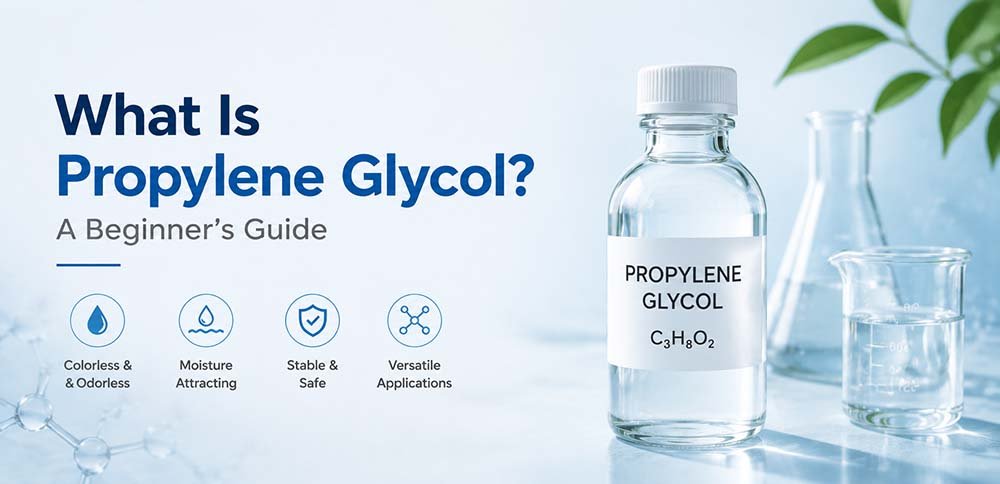
The chemical formula for propylene glycol is C3H8O2, or more specifically, CH3CH(OH)CH2OH. This structural arrangement, with two hydroxyl groups on adjacent carbon atoms, defines its classification as a 1,2-diol.
Properties:
- Viscous, clear liquid
- Miscible with water, alcohols, and many organic solvents
- Boiling point: ~188°C (370°F)
- Melting point: -59°C (-74°F)
- Density: 1.036 g/cm³ at 20°C.
- Low vapor pressure and low volatility
Propylene glycol is hygroscopic, meaning it absorbs water from its surroundings. This makes it useful for maintaining moisture and controlling consistency in various formulations.
What is Propylene Glycol Made of?
Propylene glycol is synthesized primarily from propylene oxide, a by-product of petroleum refining. However, there’s also a growing interest in bio-based propylene glycol, which is derived from renewable sources like glycerol, a waste product of biodiesel production.
Chemically, it is composed of carbon, hydrogen, and oxygen atoms arranged in a three-carbon chain with two hydroxyl groups, giving it its characteristic water-binding ability and chemical reactivity.
Production
There are two main industrial methods for producing propylene glycol:
Petroleum-Based Process:
Involves the catalytic hydration of propylene oxide.
Two-step reaction: formation of hydroxypropanol followed by purification.
Most commonly used method due to cost-efficiency.
Bio-Based Process:
Utilizes glycerol as a feedstock.
Converts glycerol via hydrogenolysis into PG.
Considered environmentally friendly, though less prevalent commercially.
The product is then refined into different grades depending on end-use:
USP/Pharmaceutical Grade: High purity, used in food, cosmetics, and drugs.
Industrial Grade: Slightly lower purity, used in antifreeze, coolants, and de-icers.
Types of Propylene Glycol for Sale
Propylene glycol is produced in various grades, each suited for specific applications based on its purity level:
Industrial Grade Propylene Glycol: This is the most common and least pure form, used in applications where direct human contact is minimal or not a concern. Examples include its use in paints, coatings, heat transfer fluids, and as an ingredient in fiberglass production.
USP Grade Propylene Glycol (Pharmaceutical Grade): This is a highly purified grade that meets the strict standards set by the United States Pharmacopeia (USP) and other international pharmacopeias (like the European Pharmacopoeia – EP). It is virtually odorless and tasteless, and its purity ensures it’s safe for use in pharmaceuticals, cosmetics, and certain food products. This is the grade used in medications, injectable solutions, and high-quality personal care items.
Food Grade Propylene Glycol (FCC Grade): This grade meets the standards of the Food Chemicals Codex (FCC), ensuring its purity and safety for use as a direct food additive. It is often synonymous with USP grade, as USP standards typically encompass the purity required for food applications.
Need USP or food-grade propylene glycol? PropyleneGlycol.net stocks both grades with full batch documentation. Request a quote and Certificate of Analysis: https://propyleneglycol.net/contact
What is Propylene Glycol Used For?
Propylene Glycol’s unique properties as a solvent, humectant, emulsifier, and carrier make it valuable in both consumer-facing and industrial products. Therefore, it is versatile in a wide range of industries – from food and pharmaceuticals to cosmetics and industrial manufacturing.
1. Food and Beverage Industry
In the food sector, propylene glycol is classified as an additive (E1520 in the EU) and is widely regarded as safe when used within regulated limits.
Primary Functions:
Solvent for flavors and extracts: PG helps dissolve flavoring agents and food colors that are not water-soluble, ensuring even distribution in processed foods.
Humectant: Maintains moisture in baked goods, snacks, candies, and icings to prevent drying and extend shelf life.
Carrier for emulsifiers and enzymes: PG can deliver enzymes and emulsifiers effectively in processed dairy and meat products.
Stabilizer: Helps maintain texture and consistency in ice creams, frostings, and soft drinks.
Example: In vanilla extract, PG is often used as a carrier to dissolve and stabilize natural vanillin.
2. Pharmaceutical and Medical Use
Propylene glycol is commonly found in both prescription and over-the-counter medications.
Key Applications:
Solvent in oral and injectable drugs: PG ensures that active ingredients are evenly dispersed and absorbed effectively.
Topical formulations: Acts as a penetration enhancer in creams and ointments, aiding in the delivery of active compounds through the skin.
Syrups and elixirs: Its slightly sweet taste makes it suitable as a base in cough syrups and pediatric medicines.
Example: Many injectable medications, including diazepam, use PG as a solvent to enhance solubility and stability.
3. Cosmetics and Personal Care Products
One of the most well-known uses of propylene glycol is in cosmetics and toiletries.
Functions in Formulations:
Humectant: Helps the skin retain moisture, making it a key ingredient in moisturizers, lotions, and facial masks.
Emulsifier and stabilizer: Keeps oil- and water-based ingredients from separating in products like creams and shampoos.
Solvent: Ensures the proper dispersion of active ingredients, fragrances, and preservatives.
Texture enhancer: Contributes to the smooth and creamy feel of cosmetic products.
Example: PG is often found in deodorants, shaving gels, and skin serums to improve product stability and performance.
4. E-Liquids and Vaping
In the vaping world, propylene glycol is a critical base liquid for e-cigarettes and vape pens.
Role in E-Liquids:
Solvent for nicotine and flavorings: Helps evenly distribute nicotine and flavoring substances in the e-liquid.
Throat hit enhancer: PG produces a stronger throat sensation that mimics the experience of traditional smoking.
Vapor production: Produces less visible vapor compared to vegetable glycerin but provides a more intense flavor.
Example: Most e-liquid formulas include a PG/VG (propylene glycol/vegetable glycerin) ratio such as 70/30 or 50/50, depending on desired vapor thickness and flavor delivery.
5. Industrial and Chemical Applications
PG’s stability, low toxicity, and water solubility make it valuable in a variety of industrial settings.
Industrial Uses Include:
Antifreeze and de-icing fluids: PG lowers the freezing point of water and is used in formulations for aircraft de-icing and vehicle coolants (as a safer alternative to toxic ethylene glycol).
Hydraulic and brake fluids: Used in systems that require high-performance, water-soluble fluids.
Heat transfer fluids: Common in closed-loop systems like HVAC and geothermal systems due to its thermal stability and low corrosiveness.
Plasticizers and paints: Acts as a plasticizer in coatings, inks, and adhesives to improve flexibility and durability.
Example: In food-processing plants, PG-based antifreeze is preferred for systems with possible food contact.
Sourcing propylene glycol for industrial or bulk use? We supply drums, totes, and bulk tanker volumes with SDS and REACH/FDA compliance documents included. Get a bulk pricing quote: https://propyleneglycol.net/contact
6. Animal Feed and Veterinary Use
PG is used in animal nutrition and veterinary formulations, though with some restrictions.
Usage in Animal Health:
Feed additive for livestock: In ruminants like cattle, PG can serve as a glucose precursor, especially to treat ketosis.
Solvent in veterinary medications: Similar to human medicine, it serves as a carrier for active ingredients in veterinary syrups and topical treatments.
Important Note: PG is not recommended for use in cat products due to potential red blood cell sensitivity.
7. Tobacco, Paints, and Miscellaneous Uses
PG is also present in other less prominent but important applications.
Additional Uses:
Tobacco products: Used to maintain moisture in smokeless tobacco and pipe tobacco.
Paint thinners and resins: Acts as a solvent in specialty coatings and water-based paints.
Humidifiers and theatrical fog: PG is vaporized to create fog or mist effects in concerts, films, and theme parks.
Why Propylene Glycol Is So Widely Used?
PG’s wide acceptance stems from its unique combination of safety, chemical compatibility, and multifunctionality. It is:
Compatible with many ingredients
Stable under a variety of conditions
Inexpensive and easy to manufacture
Safe for human consumption when regulated
These characteristics allow PG to serve as a kind of “universal ingredient”—fitting seamlessly into many different chemical and biological systems.
Is Propylene Glycol Safe?
The safety of propylene glycol is a frequently asked question, and the answer, backed by extensive scientific research and regulatory assessments, is a resounding yes when used within established limits for its approved applications.
Major international and national regulatory bodies have thoroughly evaluated PG:
- U.S. Food and Drug Administration (FDA): The FDA considers propylene glycol to be “Generally Recognized As Safe (GRAS)” for use as a direct food additive. This classification is based on decades of scientific evidence and a long history of safe consumption. (Source: U.S. FDA, fda.gov)
- Joint Expert Committee on Food Additives (JECFA) of the World Health Organization (WHO) and Food and Agriculture Organization (FAO): JECFA has established an Acceptable Daily Intake (ADI) for propylene glycol, indicating the amount that can be consumed daily over a lifetime without posing an appreciable health risk.
- European Food Safety Authority (EFSA): EFSA has also reviewed and approved propylene glycol (E1520) for use in various food and other applications within the European Union.
Metabolism in the Human Body: When ingested, propylene glycol is rapidly absorbed and metabolized. It is converted into lactic acid, a substance naturally produced by the human body during exercise. The lactic acid is then further broken down into pyruvate and carbon dioxide, or excreted by the kidneys. Critically, propylene glycol does not accumulate in the body, which is a key factor in its low toxicity.
Potential Concerns and Allergic Reactions: While generally well-tolerated, some individuals may experience mild reactions, particularly with topical applications:
- Skin Irritation (Irritant Contact Dermatitis): In very sensitive individuals or at high concentrations, PG can cause mild skin irritation, redness, or itching. This is more common in people with pre-existing skin conditions like eczema or broken skin.
- Allergic Contact Dermatitis: True allergic reactions to propylene glycol are rare but possible. Symptoms might include persistent itching, blistering, or a widespread rash. If such symptoms occur, it’s advisable to consult a dermatologist for patch testing. It’s important to distinguish this rare allergic response from general irritation.
Environmental Safety:
Propylene glycol is easily biodegradable under aerobic conditions in freshwater, in seawater and in soil. Therefore, it is considered as environmental-friendly. (Wikipedia-Propylene_glycol)
Propylene Glycol vs. Vegetable Glycerin
These two ingredients are often compared, especially in the context of e-liquids and cosmetics.
| Feature | Propylene Glycol (PG) | Vegetable Glycerin (VG) |
| Source | Synthetic or bio-based | Plant-based (from vegetable oils) |
| Viscosity | Less viscous, thinner | More viscous, thicker |
| Taste | Slightly sweet | More sweet |
| Vapor Production | Less dense | Thicker vapor |
| Throat Hit (Vaping) | Stronger | Milder |
| Solubility | High | Moderate |
| Moisture Retention | Excellent | Excellent |
| Applications | Broad range (food, pharma, cosmetics, industrial) | Broad range (food, pharma, cosmetics, some industrial) |
PG is favored for its solubility and stronger “throat hit” in vaping, while VG is more natural and preferred for thicker formulations.
FAQs
Q1: Is propylene glycol vegan, halal, or kosher?
Yes. Most propylene glycol is vegan-friendly, halal, and kosher. Because it is generally synthesized from petroleum or plant-based glycerol and contains no animal ingredients. And it is certified by many authorities over the world.
Q2: Can PG be ingested safely?
Yes, in small regulated quantities. It is widely used in food and medicine.
Q3: Is PG safe for pets?
It is not recommended for cats, as they may be more sensitive to it. Always consult a veterinarian.
Q4: Is it natural or artifical?
Propylene glycol is synthetic, although biobased (plant-derived) versions are available. It is not found naturally in the environment.
Q5: Can PG cause cancer?
There is no scientific evidence linking propylene glycol to cancer. It has been extensively studied for safety.
Q6: Can I be allergic to PG?
Yes, though it is rare. Symptoms may include skin redness or itching.
Summary
Propylene glycol plays a vital role in modern life—appearing in everything from packaged foods and skin creams to medicines and industrial products. Its ability to retain moisture, dissolve ingredients, and remain stable makes it essential in countless applications.
Whether derived from petroleum or renewable sources, PG continues to be recognized as safe by major health authorities worldwide. As demand grows for cleaner, more sustainable ingredients, bio-based propylene glycol is gaining ground—offering the same functionality with a greener footprint.
Understanding the properties and practical applications of PG helps consumers and manufacturers make smarter, more informed decisions in a world increasingly focused on transparency and safety.
Final Thoughts
Propylene glycol is a small ingredient with an outsized role across the products we rely on every day. Getting it right in your own formulation starts with sourcing a grade you can trust and a supplier who can back every batch with documentation.
Why Source From PropyleneGlycol.net?
- USP/EP and food-grade propylene glycol with a Certificate of Analysis on every batch
- Flexible order sizes, from small R&D trial orders to full bulk tanker volumes
- SDS, REACH, and FDA compliance documentation provided with every order
- Responsive technical support for formulators, procurement teams, and manufacturers
Ready to get a quote? Contact our team at https://propyleneglycol.net/contact and we will help you find the right grade, volume, and documentation for your application.